1716
Deception Point1716 is the date on which the Milne Ice Shelf meteorite’s claimed history rests: according to the investigators’ ice-core analysis, it fell that year and remained untouched beneath a flawless, continuous glacier. The same date appears in an account of a bright fireball seen over northern Canada, allowing the scientists to connect the meteorite to the Jungersol Fall. That convergence initially turns a geological estimate into powerful corroboration; later, evidence of saltwater and plankton in the shaft unsettles the claim that the surrounding ice had been an undisturbed, closed environment.
The Date Read in Ice
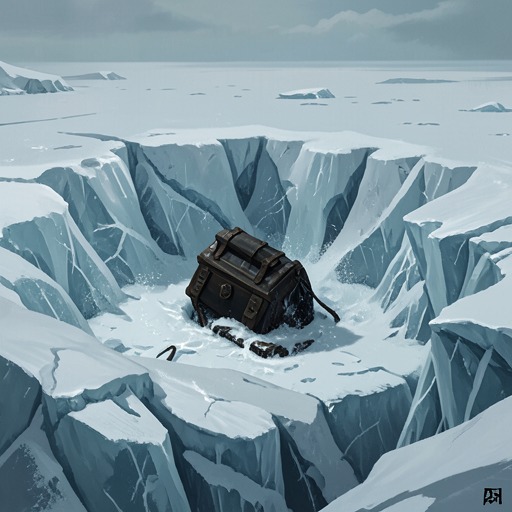
Norah Mangor explains the dating method by comparing the glacier to a layered record. In ordinary archaeology, depth can indicate how long an object has been buried; in a glacier, accumulated ice above an object can likewise help date its arrival. To make those measurements reliable, the team has drilled bore holes across the ice sheet and checked that the area is a single, structurally continuous slab rather than ice disturbed by faulting, fissures, earthquakes, or avalanches.
Her conclusion is categorical: the glacier is flawless, with no fault lines or glacial turnover. On that basis, she identifies the meteorite as a static fall, preserved untouched since it landed in 1716. The date is not presented as a guess based on one exposed surface. Mangor points Rachel toward cylindrical ice-core samples, whose visible layers preserve the glacier’s geological record, and explains that she was brought in specifically to read the ice.
Independent Corroboration
The date gains authority through an independent check. Michael Tolland tells Rachel that NASA had arrived at the same impact year before the team reached the site; Mangor then drilled her own cores, conducted her own tests, and confirmed the agency’s result. The agreement matters because it joins separate analyses rather than relying only on NASA’s initial claim.
A second line of evidence comes from the historical record. Mangor notes that 1716 was also the year early explorers reported seeing a bright fireball over northern Canada. The meteor was named the Jungersol Fall after the leader of that expedition. Corky Marlinson draws the inference: with the ice-core date and the historical account matching, the meteorite appears to be a fragment of the same body recorded in 1716. The year thus links the site’s physical record to an earlier human account of a meteor in the sky.
The Date Under Question
The certainty attached to 1716 becomes vulnerable when Rachel considers the plankton and saltwater found in the pool beneath the glacier. Although the NASA administrator has rebutted the frozen-plankton explanation, Rachel’s analysis continues to favor plankton frozen into the ice as the simplest account. She also wonders whether Mangor, if she had seen the plankton and recognized an error in her claim of a solid glacier, might be trying to cover it up. The thought is Rachel’s suspicion, not proof that Mangor altered or misrepresented the cores.
Rachel identifies the specific claim now at stake: she has just briefed the entire White House staff that the meteorite lay in pristine ice and had been sealed off from outside influence since 1716, when it broke off from the Jungersol meteorite. In light of the pool, she says, that fact is in question. Tolland agrees that the saltwater and plankton mean the shaft cannot be treated as a closed environment, whatever their explanation. This challenge concerns the integrity of the surrounding ice and the certainty of the meteorite’s isolation; it does not, at this point, establish that the fossils themselves are inauthentic.
What the Year Can and Cannot Prove
Corky tries to separate the uncertainty about the ice from the claim about the fossils. In his view, a mistake in ice-core dating would not by itself invalidate the meteorite or the fossils, which he says no one is questioning. His response exposes the distinction between two claims that had been presented together: that the meteorite contains evidence of life beyond Earth, and that its position in a pristine glacier establishes a precise, undisturbed history reaching back to 1716.
The date’s importance therefore changes with the evidence. At first, agreement between independent cores and the Jungersol account makes 1716 a powerful point of identification. Once the shaft’s apparently open environment is revealed, the same date no longer guarantees that every part of the surrounding ice record is secure. It remains the year claimed for the fall and the historical match, but the confidence placed in the meteorite’s isolation—and in the setting used to support its provenance—has become contested.